How AI Is Blurring the Line Between Paid Ads and Organic Search
AI is blurring the line between paid and organic search, making SEO and PPC part of the same connected system.
September 11, 2026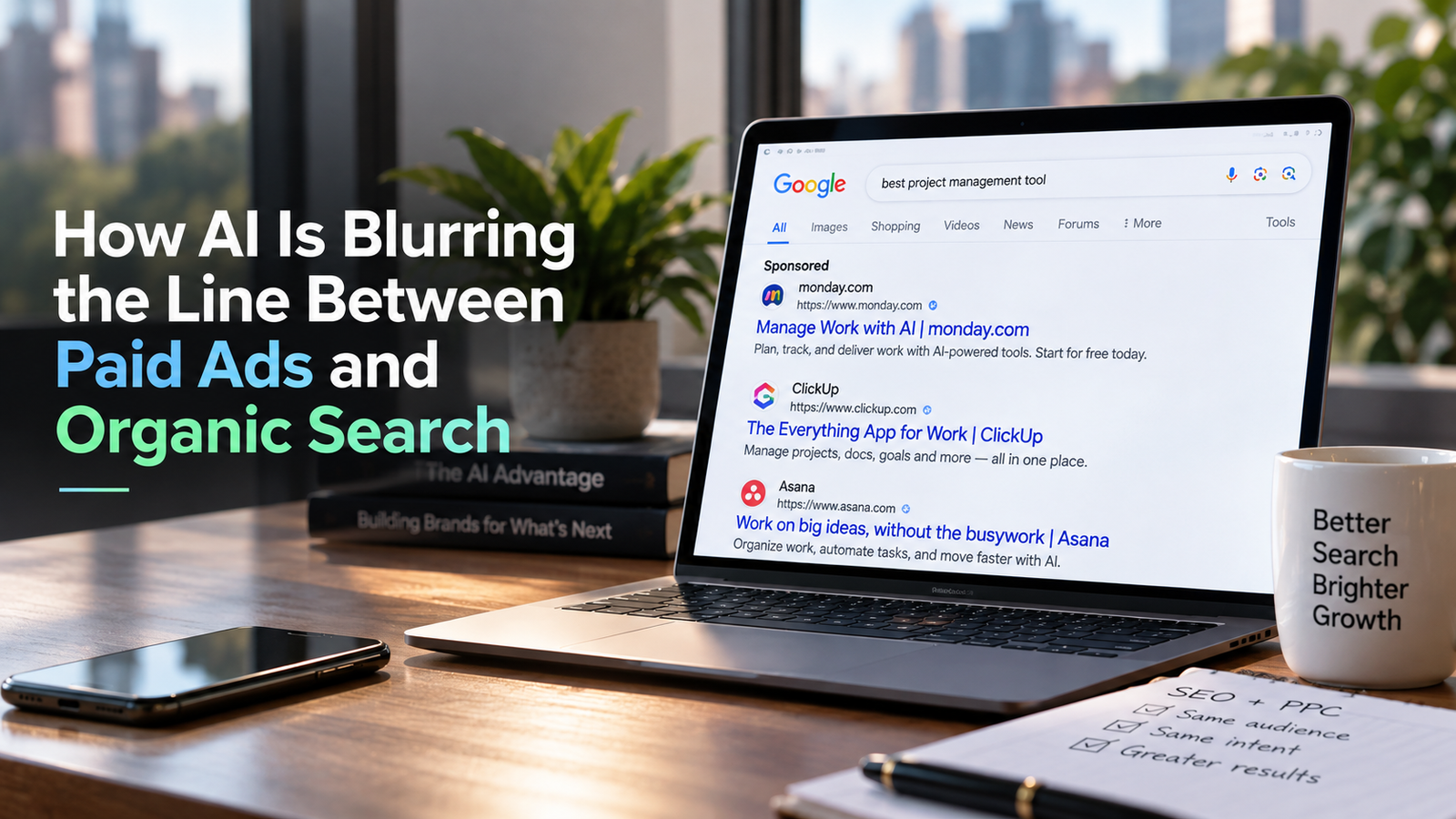
For years, Google search worked in a predictable way. You typed something, got ten blue links, saw a few ads at the top, and clicked. The team running paid ads and the team doing SEO sat in different parts of the office, worked on different tools, and barely spoke to each other. Paid was paid. Organic was organic. Simple.
That separation is gone now, and most marketing teams haven't caught up.
The Old Wall Between Paid and Organic No Longer Exists
Google's AI system, Gemini, now runs underneath almost everything Google does: Search, YouTube, Gmail, Maps, Google Pay, Android, and more. It doesn't just answer questions. It decides which ads to show, who to show them to, what the ad should say, and when to show it.
The same brain that ranks your website organically is also running your paid campaigns. That's the fundamental shift. If Gemini doesn't understand your brand well, it can make poor decisions on both sides: your organic rankings suffer, and your ads underperform at the same time.
Ads Aren't Dying — They're Spreading
A common argument in 2026 is that AI is killing advertising because fewer ads appear inside AI responses. But that misses the bigger picture.
Yes, ad density inside a single AI conversation may be lower than on a traditional search results page. But Gemini now sits across numerous surfaces that historically carried different types of advertising or user experiences. The potential advertising ecosystem is expanding even if each individual surface carries fewer ads.
Think of it as a flock of geese. Search was the original goose laying golden eggs. That goose may be slowing, but Google has built a much larger flock: YouTube, Gmail, Maps, Shopping, Android, Pixel devices, and other products powered increasingly by the same AI infrastructure.
Microsoft has some comparable surfaces through Copilot and Bing, while OpenAI is also exploring advertising and monetisation models. Google's structural advantage is the combination of an AI system, a mature advertising platform, and a massive ecosystem of consumer products.
The Freemium Deal Hasn't Changed
The internet has long operated on a simple contract: users get access to services for free in exchange for seeing advertising. Platforms such as YouTube have demonstrated how successfully this model can operate at scale.
What is changing is how advertising looks.
Traditional search ads were clearly labelled and visually separated from organic results. AI-driven recommendations can feel very different. A product recommendation inside an AI-generated summary or an agent selecting a supplier on a user's behalf can make commercial content feel like a natural part of the experience.
When that recommendation is useful and relevant, users may respond to it very differently than they would to a traditional banner advertisement.
Paid and Organic Now Feed the Same Machine
This is where the shift becomes most important for marketers. AI-driven systems increasingly depend on signals that help them understand three fundamental things:
- Cohort: Who the audience is.
- Intent: What they want right now.
- Profit: How commercially valuable that audience is.
In a paid campaign, marketers provide many of these signals explicitly through targeting, creative, bidding, conversion data, and campaign structure.
In organic search, Google has to infer user satisfaction and relevance from signals such as engagement, search behaviour, page usefulness, brand authority, and conversions.
The important idea is that strong organic content and clear brand signals can help Google's systems better understand what your company offers, who it serves, and when it is relevant. Paid and organic efforts therefore increasingly reinforce the same broader understanding of your brand.
One investment in clearer audience, intent, and brand signals can support multiple marketing outcomes.
When Google's Systems Don't Understand Your Brand
One way to think about weak brand signals is as a series of hidden “taxes” that make marketing less efficient.
- The doubt tax: Unclear positioning can weaken how your brand is represented across search and advertising experiences.
- The ghost tax: Competitors with clearer authority and positioning can dominate comparisons and attract more attention.
- The invisibility tax: If your brand has little relevance or authority around a topic, it becomes harder to compete for visibility.
- The mistrust tax: Weak landing-page quality, relevance, or user experience can increase advertising costs and reduce performance.
- The intent tax: Mixing very different audiences or intents inside the same campaign can create noisy signals and waste budget.
The opposite is also true. When your positioning is clear, your pages are relevant, and your audience signals are consistent, both paid and organic activity can become more efficient.
The Practical Takeaway
Use paid campaigns to discover which combinations of audience, intent, product, and message actually convert.
Then build organic landing pages and content around those proven combinations. Each page should be designed for a specific user need rather than trying to rank broadly for everything.
This creates a powerful feedback loop:
- Paid campaigns reveal high-converting audiences and intents.
- Organic pages are built around those proven needs.
- More relevant pages improve engagement and conversion rates.
- Cleaner conversion data improves marketing decisions.
- Paid and organic strategies become increasingly aligned.
Better pages create better conversions. Better conversions create cleaner signals. Cleaner signals help both paid and organic marketing become more efficient.
Paid and Organic Are Becoming One Connected Loop
The bottom line is straightforward: paid and organic search can no longer be treated as completely separate disciplines.
They are increasingly two different ways of influencing and informing the same AI-driven ecosystem.
Brands that connect SEO, paid media, audience insights, landing-page performance, and conversion data can build a much stronger feedback loop than brands that manage each channel in isolation.